THORPENESS AND ALDRINGHAM HERITAGE GROUP
  • Home
  • About
  • Heritage Trail
  • The Meare Board 1
  • The Golf Club Board 2
  • The Windmill and The House in the Clouds Board 3
  • The Haven and The Whinlands Board 4
  • The Dolphin & Shops Board 5
  • The Country Club Board 6
  • The Beach and The Benthills Board 7
  • History of the Village 1906
  • Buildings
  • The Almshouses
  • Thorpeness Halt
  • Interviews
  • Views
  • Ship Wreck
  • Articles
  • Aims
  • Membership
  • Contact

ARTICLES 

The Providence Baptist Chapel & its Predecessor   Aldringham Common

1/23/2018

5 Comments

 
I wonder what it is about the local environment that has engendered such innovative (or dare I say indulgent?) architecture within this relatively small coastal parish? Notwithstanding the playful designs of G S Ogilvie, F Forbes Glennie and W G Wilson for Thorpeness, Cecil Howard Lay FRIBA is responsible for some highly unusual and delightfully quirky buildings in and around Aldringham. Cecil Lay was born in Aldringham School House in 1885 and spent most of his life in the parish.  Although Lay is best known for his architecture, he was an equally talented artist and poet.  Full details of his life and work, including a splendid film made in 1964 and presented by the broadcaster Lance Sieveking, are available on the parish website.
 
The most prominent of Lay's buildings is the late Art Nouveau house Raidsend (now Aldringham Court Nursing Home) which was designed for his widowed mother in 1912. This building shows the influence of William Morris and Edward Lutyens with inspired touches all of Lay's own.  Hidden away on the common to the south of the B1353, is a
remarkable group of houses comprising Colts Hill, Pantiles, Pan Cottage, Bird's Farmhouse
and Fen Cottages.
 
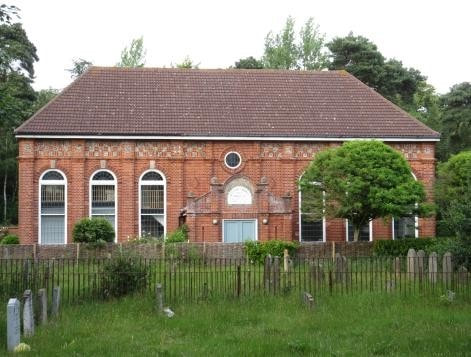
Another one of Lay's architectural surprises is the seven-bay, brick, nominally Neo- Georgian, former Providence Baptist Chapel (now a private house) on the common to the north of the B1353. It has three tall round-arched windows to either side of a three-bay porch and the seven bays are separated by giant pilasters whose capitals and the frieze between them is chequers of brick and stone.  I will not forget my amazement at encountering this classical, essentially urban edifice emerging from the heathland as I walked over the common towards The Follies.

​
 
Picture

The existing chapel, which was erected in 1914-15, replaced a much plainer building of 1812. The old chapel was far more restrained and traditional in design, with two front entrances leading into small vestibules giving access into the chapel and galleries by separate doors. The sittings were within high box pews and across the front of the chapel on either side of the pulpit were rows of two-seat pews; the one nearest to the pulpit being reserved for the appointed Deacon who announced the hymns.  The galleries were on both sides and at the rear, one side being reserved for the Sunday School scholars.  The seating capacity was about 800, which was well occupied during the 19th century but was totally inadequate for special occasions such as the Sunday School Anniversaries.
 
The old chapel was illuminated by a chandelier of oil lamps hanging from the centre and smaller oil lamps hung on the walls.  Outside the chapel was an enclosed burial ground, a thatched-roofed stable on the east side and a well on the west side. Despite the chapel's isolated position, it was within view of Stone House, a gentleman's residence to the rear (north) who owned the land bordering the chapel.  He was so annoyed at the prospect of a Conventicle barely visible from his drawing room that he planted a screen of fir trees to hide the chapel from view. Additions to the old chapel were made over the years and it was reconstructed in 1856, but by 1914 it was considered unsafe and demolished. Lay's chapel was erected on the same site, but with the pulpit on the east side instead of the north side as in the old chapel. Fundraising over the previous eleven years resulted in a tender of £1,228 5s 6d from Mr. G A Smyth, a Leiston builder, being accepted in March 1914. A
large congregation of Strict Baptists assembled on April 5th 1915 for the opening of the new chapel, which was named 'Providence' as an outer token of the Providential care and guidance that had led the worshippers to that day.
 
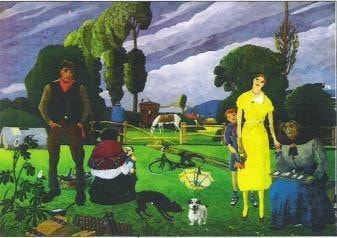
This article would be incomplete without a glimpse of Cecil Lay's diverse creative gifts.  He travelled to Belgium and The Netherlands to study painting, becoming a close friend of Frank Brangwyn who influenced his work. He also corresponded with the poet Ezra Pound. As a Suffolk countryman, Lay was a keen observer of nature and made a detailed study of the behaviour of his pet tortoise, discovering that it performed a ceremonial dance after emerging from hibernation. He submitted his observations to the Illustrated London News, 4th July 1953, less than three years before he died on 6th February 1956. Cecil Lay is buried in Aldringham churchyard with his wife Joan, who died in 1980.

Janey Blancheflower 

​
Picture
Forecasting a Loss by Cecil Lay: Ipswich Borough Museums & Galleries
5 Comments
Jonathan Harding
5/11/2021 08:47:09 am

I am the grandson of the last Pastor of Aldringham Baptist Church, Percy Marjoram. This gives for interesting reading. Many of my ancestors are buried in the grave yard adjacent to the building

Reply
Susan Cole
8/27/2023 05:36:14 am

I am 3x grandaughter of a former minister of Aldringham Baptist Chapel - Joseph Brand b1802 Rayleigh Essex d1884 WangfordSfk. Trained Rayleigh under rev Pilkington, appointed to Aldringham. moved on to Bungay Baptist Chapel. Buried in Bungay cemetery, grave still standing and inscr.iption legible, Several children, one died Aldringham and pos burried Aldrinham

Reply
Peter Mason
4/4/2024 04:04:48 am

Read the interesting article about Cecil Lay.
I am looking to make a record of all his houses and obtain a copy of the film made for AngliaTV
A Suffolk Gentleman.
I would be grateful for any information
Best wishes
Peter Mason RIBA

Reply
Bree Bites link
10/15/2024 05:32:46 pm

Nice blog you hhave

Reply
Debbie Stacey
6/7/2025 09:07:31 am

I am the Great Grandaughter of Robert & Ruth Wilson who are buried in front of the Baptist Chapel. I have also researched my maternal family tree and many other relatives are buried there too. We visit every Christmas time to lay flowers on the grave.

Reply


Leave a Reply.

Proudly powered by Weebly
  • Home
  • About
  • Heritage Trail
  • The Meare Board 1
  • The Golf Club Board 2
  • The Windmill and The House in the Clouds Board 3
  • The Haven and The Whinlands Board 4
  • The Dolphin & Shops Board 5
  • The Country Club Board 6
  • The Beach and The Benthills Board 7
  • History of the Village 1906
  • Buildings
  • The Almshouses
  • Thorpeness Halt
  • Interviews
  • Views
  • Ship Wreck
  • Articles
  • Aims
  • Membership
  • Contact